




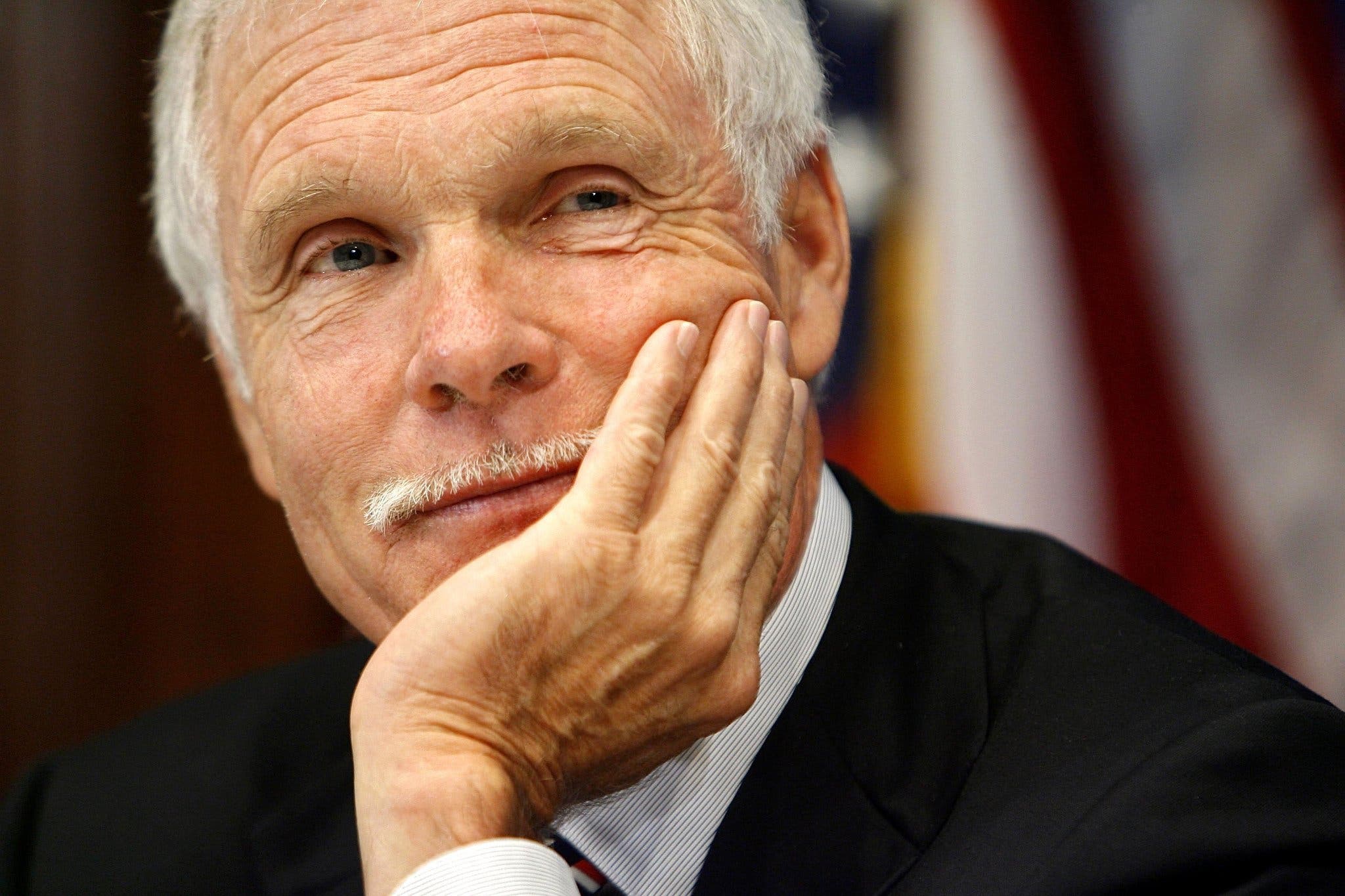
Ted Turner, the media mogul who created CNN and transformed television news with the 24-hour news cycle, died Wednesday at his home near Tallahassee, Florida. He was 87.
His death was confirmed by family spokesman Phillip Evans. Turner had announced in 2018 that he was living with Lewy body dementia.
The Man Who Changed How We Watch News
Turner’s signature achievement was CNN, the Cable News Network, launched in 1980. At a time when Americans relied on nightly broadcasts from ABC, CBS and NBC, Turner bet that viewers wanted news around the clock. The gamble paid off. CNN brought live, continuous coverage of events like the fall of the Berlin Wall, Tiananmen Square and the 1991 Persian Gulf War, making history available as it unfolded.
“I learn more from CNN than I do from the C.I.A.,” President George H.W. Bush was widely quoted as saying during the Gulf War.
CNN was just one part of a sprawling media empire. Turner also launched CNN Headline News and CNN International, and built the Turner Broadcasting System into a cable powerhouse that included TBS, TNT and Turner Classic Movies. He acquired the MGM film library in 1985 and the Hanna-Barbera cartoon archive in 1991, using it to launch the Cartoon Network in 1992. In 1996, he merged Turner Broadcasting with Time Warner in a $7.5 billion deal that created one of the world’s largest media companies.
A Risk-Taker On and Off Screen
Born Robert Edward Turner III on Nov. 19, 1938, in Cincinnati, Turner was a restless entrepreneur who often operated on the edge of financial ruin before emerging with bigger wins. In 1970, he bought a failing Atlanta television station and used it to broadcast Atlanta Braves baseball games nationwide via satellite, creating the nation’s first “superstation,” TBS. The same approach fueled CNN’s early growth.
Turner was also an accomplished yachtsman, captaining the winning _Courageous_ in the 1977 America’s Cup. He owned the Atlanta Braves and Hawks, using TBS to give the teams national exposure decades before streaming.
His personality matched his ambition. Nicknamed “the Mouth of the South,” Turner was known for brash comments, heavy drinking and public feuds. Rivals like Rupert Murdoch once ran headlines questioning his sanity, yet even Murdoch acknowledged Turner’s influence on modern media.
“I’m trying to set the all-time record for achievement by one person in one lifetime,” Turner told _Reader’s Digest_ in 1998, placing himself alongside figures like Alexander the Great and Gandhi.
Philanthropy and Contradictions
Turner’s politics were often contradictory. A self-described conservative Republican with ties to Christian evangelical groups, he also befriended Fidel Castro and made a $1 billion donation to the United Nations in 1997 — an organization many conservatives opposed. An avid hunter, he later became a leading environmentalist, purchasing more than 2 million acres of land in the U.S. and Argentina for conservation. At his peak, he was the fourth-largest private landowner in America.
He founded the Goodwill Games to ease Cold War tensions and launched Ted’s Montana Grill to create a sustainable market for bison meat. His philanthropy extended to refugee aid, landmine clearance and nuclear disarmament through the Turner Foundation and the Captain Planet Foundation.
A Turbulent Personal Life
Turner’s personal life was as public as his business career. He was married three times, most famously to actress Jane Fonda from 1991 to 2001. The marriage united two cultural opposites: the former conservative yachtsman and the former anti-war activist. Turner has often cited his father’s 1963 suicide and the death of his sister from lupus as turning points that drove his relentless ambition.
He leaves behind five children and 14 grandchildren, including daughter Laura Turner Seydel, an environmental activist, and son Teddy Turner, a former Turner Broadcasting executive.
Legacy
Turner’s influence endures in the way news is delivered today. By proving that 24-hour news could be commercially viable, he reshaped the media landscape and paved the way for cable and digital news outlets worldwide. While his business style was unpredictable and his public statements often controversial, his impact on American culture and global journalism is undeniable.
As CNN’s coverage from Baghdad during the Gulf War earned a Peabody Award, the network was recognized as having “matured from a cable curiosity to become an international service of inestimable importance.” That line captures Turner’s career: a series of improbable gambles that redefined an industry.



Comments are closed